
The 12 mistakes almost every family makes in their first homeschool year
Collected from parents who made them: the expensive purchases, the imported school habits, and the one that actually makes families quit.
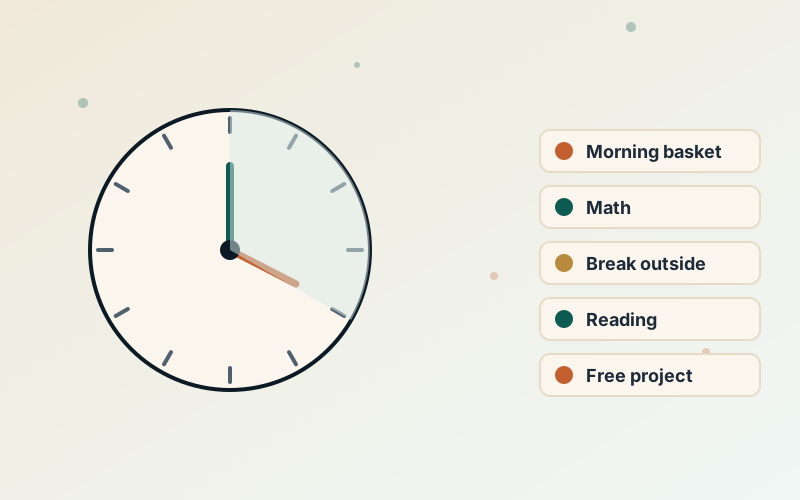
Every one of these was made by a real family, often more than once, and several of them by people who now give confident advice about avoiding them. They are stages, not character flaws. But you can skip a few, and skipping even three makes the first year noticeably kinder.
1. Buying a complete boxed curriculum in month one
The most expensive mistake, reliably. Everything arrives, beautifully sequenced, and by November three of its seven subjects are wrong for this particular child — but you paid for all seven, so you persist.
Instead: buy two spines, math and literacy. Library for the rest, for a term. Then buy deliberately, knowing your child.
2. Recreating the school day
Six hours, subject blocks, a start bell, a marking pile. Parents do this because it is the only model they have, and it is genuinely exhausting by half term.
One-to-one teaching is roughly three times faster than one-to-thirty. Most elementary families do two to three hours of focused work. If you are doing six, you are not being thorough — you are doing three times too much.
3. Skipping deschooling
Pulling a child out on Friday and starting the curriculum on Monday. It produces a fight every day for a month, and then most families deschool anyway — with considerably less goodwill left. Do it first.
4. Doing every subject, every day
Seven subjects daily is a classroom timetabling artefact, not an educational requirement. History twice a week and science once is plenty at eight. A loop schedule means nothing is permanently dropped when a day goes sideways.
5. Comparing to a year-group standard
You will look up “what should a seven-year-old know” and it will not help. Year-group expectations describe an average across thirty children with one teacher. Your child is not an average and does not have that constraint.
Children who homeschool commonly run ahead in some subjects and behind in others, sometimes by years, and it evens out. Comparison generates anxiety and produces no useful action.
6. Underestimating the parent’s need
Every first-year plan accounts for the child’s needs and none for the adult’s. You are now teacher, planner, cook and companion, all day, with no staff room.
Build in something that is yours — an hour, an evening, one thing a week that is not about anyone else. This is not indulgence; it is the load-bearing structure of the whole arrangement.
7. Isolating
The mistake that actually makes families quit. Not curriculum, not academics, not money — isolation.
Find one group in the first term. Not four. One regular thing where your children see the same faces weekly and you talk to another adult who understands. This is the single strongest predictor of still homeschooling in three years.
8. Buying the thing that worked for someone else’s child
Every curriculum has passionate advocates, and they are all telling the truth — about their child. A programme that transformed a methodical nine-year-old can be miserable for a restless six-year-old.
Read the free scope and sequence. Look at sample pages. Ask what kind of learner it suits, not whether it is good.
9. Marking everything
Every page corrected, every error circled. This is a classroom-management necessity for thirty children and unnecessary for one, and it teaches a child that work is a trap.
You watched them do it. You already know what they understood. Fix the two or three things that recur, and let the rest go.
10. Front-loading the schedule with the hardest subject
Nine in the morning is a school convention, not a fact about children. Many are genuinely unavailable for demanding work until eleven; teenagers frequently peak after lunch.
Spend a fortnight noticing when your child is actually sharp, then put the hard thing there. This costs nothing and is one of the highest-return changes available.
11. Treating the first choice as permanent
Choosing a curriculum, method or schedule feels enormous, so families persist with things that are clearly not working out of a sense of commitment.
Nearly everything here is reversible. Give a choice one full term, then change it deliberately if it is wrong. The failure mode to avoid is not changing — it is changing every three weeks.
12. Not building in a review
Without a scheduled review point, every bad week becomes a referendum on the whole decision.
Put a six-week review in the calendar now. Four questions, half an hour, both parents if there are two:
- What is genuinely working? Keep it.
- What are we dreading? Change or drop one thing.
- Is anyone unhappy in a way that is not just a hard week?
- What is one thing we will do differently for the next six weeks?
That single habit converts a crisis into a decision, and it is the closest thing to a universal recommendation in this whole piece.
Where to go next
- Your first homeschool year checklist — including the six-week review
- Deschooling explained — mistake three, in full
- Homeschool burnout: 7 signs — where several of these lead if unaddressed
- Finding or starting a co-op — the fix for mistake seven
Questions parents actually ask
What is the biggest mistake new homeschoolers make?
How long does it take to find your homeschool rhythm?
Should I buy curriculum before we start?
Is it normal to want to quit in the first year?
Got a view on this?
Share your question with other homeschool mothers and fathers, compare approaches, or find families in your area. You can read the forum before creating an account.
Get this kind of thing every Sunday
Practical, current, no fluff — one email a week.
By signing up, you agree to receive the free Vanguard Parents newsletter. Unsubscribe anytime.
Keep reading
Hand-picked next reads from the rest of the site.
Single-parent homeschooling — how families actually make it work
The four models that work when there is one adult and an income to earn, what to drop without guilt, and the support structures that make the difference.
GuideHomeschooling on a budget — a complete year for almost nothing
A genuinely free curriculum for every core subject, where to buy used, and the few purchases actually worth paying real money for.
GuideHow to find — or start — a homeschool co-op
Where local groups actually hide, what to look for before you commit, and a realistic plan for starting one from nothing with three families and a living room.