
Six homeschool schedule templates that survive real life
Loop, block, morning basket, four-day, shift and unschooling-with-anchors — six real schedules with the household each one suits, and the failure mode of each.
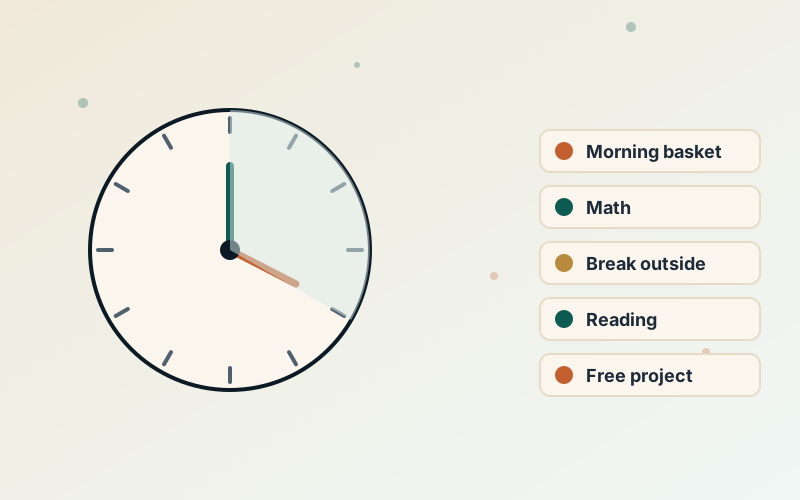
Most homeschool schedules fail for the same reason: they are designed for a good week. A schedule that only works when nobody is ill, nothing overruns and everyone is willing is not a schedule — it is an aspiration.
Below are six that survive contact with reality, each with the household it suits and the specific way it goes wrong.
1. The loop
How it works. Keep a rotating list of subjects. Each day you do the next one or two on the list, then pick up from there tomorrow. There are no assigned days.
Loop: history → science → art → geography → music → nature study → (back to history)
Suits: families with irregular weeks, working parents, anyone who feels permanently behind on the subjects that keep getting dropped.
Why it works: nothing is ever skipped, only delayed. The guilt of missing “Wednesday science” disappears because there is no Wednesday science.
Fails when: you loop something genuinely sequential. Keep maths and phonics daily and outside the loop.
2. Morning basket + blocks
How it works. Everyone together for twenty to thirty minutes to start — a read-aloud, a poem, a song, something to look at. Then individual work in blocks, staggered so you are with one child while another works alone.
8:45 Morning basket (all together) 9:15 Maths with the youngest / independent reading for the eldest 9:50 Swap 10:30 Outside 11:00 One loop subject, all together Afternoon: free, project, or outings
Suits: multiple children of different ages; families who want connection before demands.
Why it works: the shared start does the emotional work of the day before anyone is asked to do anything hard, and the overlap means one adult can serve three ages.
Fails when: the basket expands. Keep it under thirty minutes or it eats the morning.
3. The four-day week
How it works. Academics Monday to Thursday. Friday is for co-op, outings, appointments, catch-up and admin.
Suits: nearly everyone, and especially families with any outside commitment.
Why it works: the fifth day absorbs everything that would otherwise derail the other four. Most families find they cover the same content, because the four days are less interrupted.
Fails when: Friday quietly becomes a fifth academic day. Protect it.
4. Block scheduling
How it works. One subject intensively for a period, then switch. Six weeks of history, then six weeks of geography, rather than both weekly all year.
Suits: older students; subjects that reward immersion; parents who find constant subject-switching exhausting.
Why it works: depth. A teenager can get properly inside a subject rather than touching it for forty minutes twice a week.
Fails when: applied to skill subjects. Maths and languages decay without regular contact; block them and you lose more in the gap than you gain in the block.
5. The shifted / compressed day
How it works. Academics happen when the working adult is available — early morning, evenings, weekends — often compressed into fewer, longer sessions.
6:45–7:45 Maths and reading with a parent Day: independent work, checklist-driven 18:30–19:30 Review, read-aloud, the next day’s plan Saturday morning: the longer, together subjects
Suits: working parents, single parents, shift workers.
Why it works: it stops pretending that education must happen between nine and three. Nowhere requires that.
Fails when: independence has not been built. This model depends entirely on a child who can work unsupervised, which is a skill you teach deliberately from about six.
6. Unschooling with anchors
How it works. The day is genuinely child-led, with two or three fixed anchors that never move.
Anchors: twenty minutes of maths after breakfast; a read-aloud after lunch; outside every day. Everything else: follows whatever is alive that week.
Suits: interest-led families who want freedom without drift.
Why it works: the anchors carry the two things that genuinely decay without regular contact, and everything else is free.
Fails when: the anchors are treated as negotiable. Three non-negotiables and total freedom outperforms ten flexible intentions.
How many hours, by age
| Age | Focused academic work | Notes |
|---|---|---|
| 4–5 | 20–30 minutes | Plus read-alouds, play, outside |
| 6–7 | 1–1.5 hours | In short bursts, never one sitting |
| 8–10 | 2–3 hours | Usually finished before lunch |
| 11–13 | 3–4 hours | Increasing independence |
| 14+ | 4–6 hours | Mostly independent; exam years at the top of the range |
If you are substantially above these, you are doing more than required — one-to-one teaching is roughly three times faster than a classroom.
Building your own, in four decisions
- When is your child actually alert? Watch for two weeks. Put the hardest subject there, whatever the clock says.
- What is genuinely daily? Usually maths, reading and one read-aloud. Everything else can loop.
- Where is the slack? One free day, or one free afternoon, absorbs the week’s chaos. Without slack, every disruption cascades.
- What is the minimum viable day? Write it down: the three things that count as a school day when someone is ill or everything has gone wrong. Having this defined prevents a bad day from feeling like a failure.
Where to go next
- The weekly planner printable — a one-page planner for whichever template you choose
- Homeschooling several kids — loop scheduling and morning baskets in depth
- Homeschooling while working full-time — the shifted models in detail
- Record keeping and portfolios — logging whichever rhythm you land on
Questions parents actually ask
What is a good homeschool schedule?
How many hours a day should we homeschool?
What is a loop schedule?
How do you homeschool several ages at once?
Used this yourself?
Share your question with other homeschool mothers and fathers, compare approaches, or find families in your area. You can read the forum before creating an account.
More things you can actually use
Every Sunday: one practical idea, the best new posts, and whatever we have just tested.
By signing up, you agree to receive the free Vanguard Parents newsletter. Unsubscribe anytime.
Keep reading
Hand-picked next reads from the rest of the site.
How to homeschool multiple kids without losing your day
A practical scheduling system for families with two, three, four or more kids — the loop schedule, the morning basket, and the secret of overlap.
ArticleSingle-parent homeschooling — how families actually make it work
The four models that work when there is one adult and an income to earn, what to drop without guilt, and the support structures that make the difference.
GuideRecord keeping and portfolios — ten minutes a week, no dread
What to keep, what to bin, and a system that satisfies any state requirement in ten minutes a week — including for families who don't use a curriculum.